.png)
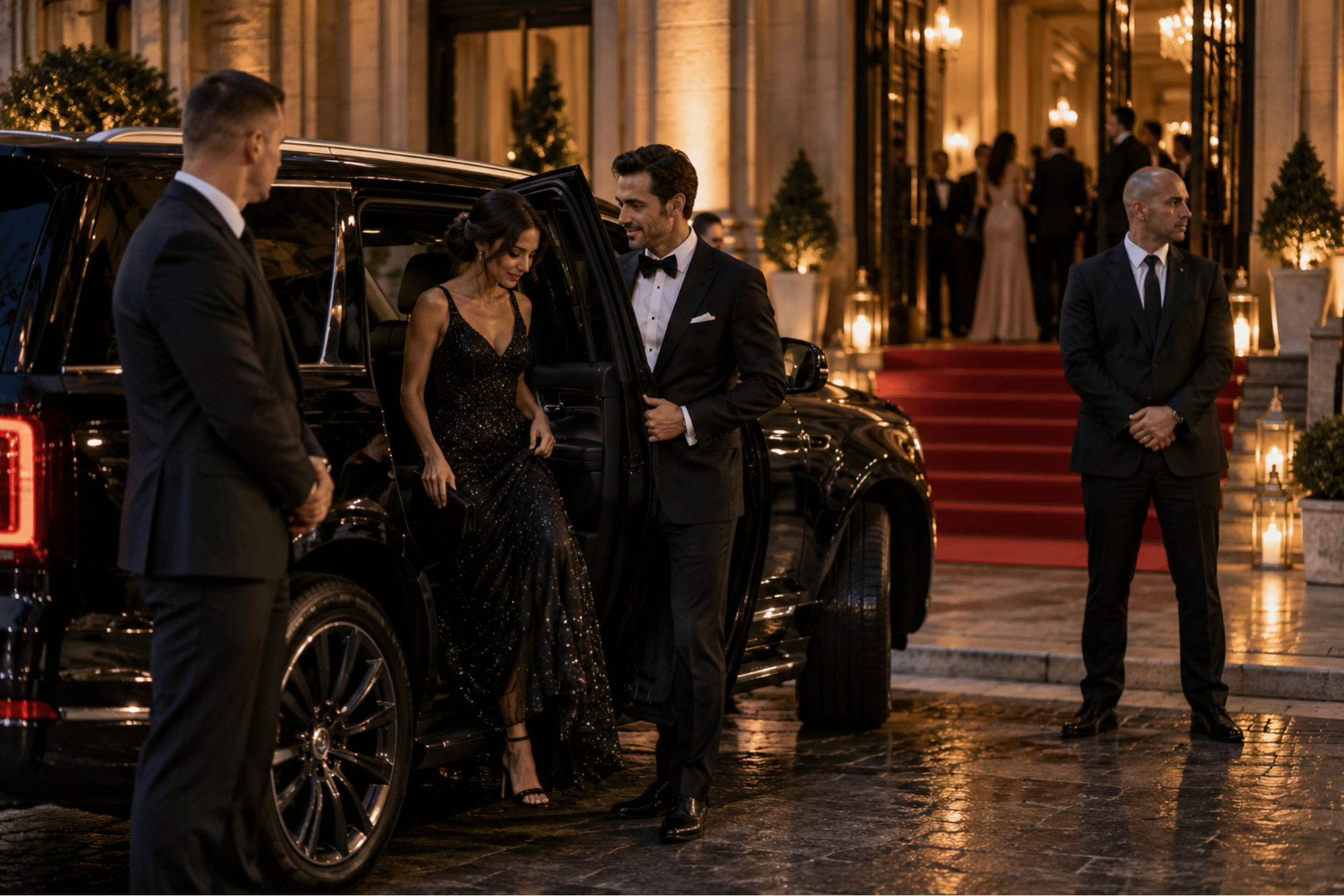
Every event has two moments that guests remember and hosts worry about: the arrival and the departure. Everything between them happens inside a venue with walls, staff, and a plan. The arrival and the departure happen at a curb, in public, on a schedule that was printed on an invitation.
For most gatherings that is a logistics problem. For some it is also a security problem. A gala with a public honoree. A wedding with recognizable guests. A shareholder meeting. A premiere. A private party for a family whose name is known.
This guide is for event planners, hosts, venue managers, and the executive assistants and chiefs of staff who plan on behalf of principals. It explains how protective agents and transportation work together at events, what a good plan includes, and how to coordinate it without turning a celebration into a checkpoint.
Why Security and Transportation Should Be Planned Together
Events usually hire them separately. A security company for the door. A car service for the VIPs. A shuttle operator for guests. A valet company for everyone else. Four vendors, four dispatchers, and one narrow driveway.
The problems appear at the points where those vendors meet:
- The VIP's car arrives and the door team does not know who is in it.
- Shuttles block the entrance at the moment the honoree pulls up.
- The principal is ready to leave early and the driver is parked a mile away because valet needed the space.
- A guest who should not be admitted arrives by shuttle, already inside the perimeter.
- Nobody owns the departure, and two hundred people are standing outside at once.
A single team responsible for both protection and movement removes those gaps. The agent at the entrance knows which vehicle is two minutes out. The driver knows which door the agent wants. The shuttle loop is timed around VIP arrivals. One person runs the radio.
The reason this is rare is licensing. Security and for-hire transportation are regulated separately, and very few companies hold both authorities. Stealth Protection holds both the transportation license and the executive protection license. Agents, chauffeurs, security drivers, and vehicles come from one company, under one standard, with one point of contact for the planner. No subcontracting and no handoffs.
Which Events Need Protective Planning
Not every event does. These usually do.
- Galas and fundraisers with public honorees, elected officials, or prominent donors, particularly when the guest list or seating has been publicized.
- Weddings with high-profile families or guests, or with any family circumstance that could produce an unwelcome arrival.
- Corporate events: shareholder meetings, investor days, product launches, leadership offsites, and holiday parties following a difficult year.
- Premieres, openings, and performances where talent arrives through a public entrance.
- Private parties at residences, where the home itself is opened to vendors and guests.
- Memorial services and funerals for prominent individuals, where attendance is public knowledge and emotions run high.
- Milestone celebrations for families who value privacy: significant birthdays, anniversaries, bar and bat mitzvahs, graduations.
The common thread is a known time, a known place, and at least one attendee whose presence matters to someone outside the guest list.
The Four Parts of an Event Plan
1. The advance
Everything good about event security happens before the first guest arrives. An agent visits the venue and works through:
- Every entrance and exit, including service doors, loading docks, and kitchen routes.
- A private arrival point for principals, away from the main entrance if needed.
- Vehicle staging: where VIP vehicles wait, where shuttles load, where valet operates, and how they stay out of each other's way.
- A holding room for principals.
- The route from the arrival point to the principal's table or the stage.
- Emergency exits, the nearest hospital, and local police and fire contacts.
- The venue's own security, its manager, and who has authority on the night.
- Cell coverage and radio function inside the building.
- Weather contingencies for outdoor elements.
The advance produces a short written plan shared with the planner and the venue.
2. Arrivals
- Principals arrive on a schedule that is not printed anywhere. Either before guests, or through a secondary entrance during the cocktail hour.
- The agent is at the door before the vehicle stops. The walk from the car to the inside is measured in seconds.
- Guest list management is courteous and firm. Trained agents in formal attire check names discreetly, handle plus-ones and surprises with tact, and refer problems to the planner quietly.
- Vendors enter separately, are identified, and stay in their areas.
- Shuttles run a loop timed to avoid the principals' arrival window.
3. During the event
- Agents position according to the plan: close to the principal, at entry points, and roaming.
- They are dressed as guests or staff and behave accordingly.
- Private areas of a home or venue stay private.
- Gifts, auction items, and valuables are monitored.
- Intoxicated or disruptive guests are handled quietly, ideally by their own friends, with an agent nearby.
- VIP vehicles remain staged and attended, ready to leave on a minute's notice.
4. Departures
The departure is the hardest part of the night and the one most often left unplanned.
- Principals leave before the rush or after it, through the planned exit, with the vehicle already at the door.
- Shuttles are staged early and leave on a published schedule, with a final run that is actually final.
- Guests who should not drive are offered a ride. Hosts increasingly arrange a few standby vehicles for this purpose. It is a kindness and a prudent step.
- The team stays until the host and the planner are finished, and the last vehicle leaves after they do.
Transportation Roles at an Event
Principal vehicles. A dedicated Cadillac Escalade ESV with a security driver for each principal or family. The vehicle stays attended all evening.
VIP guest vehicles. Chauffeured SUVs for honorees, speakers, major donors, and family elders, booked through our hourly chauffeur service so they are available throughout.
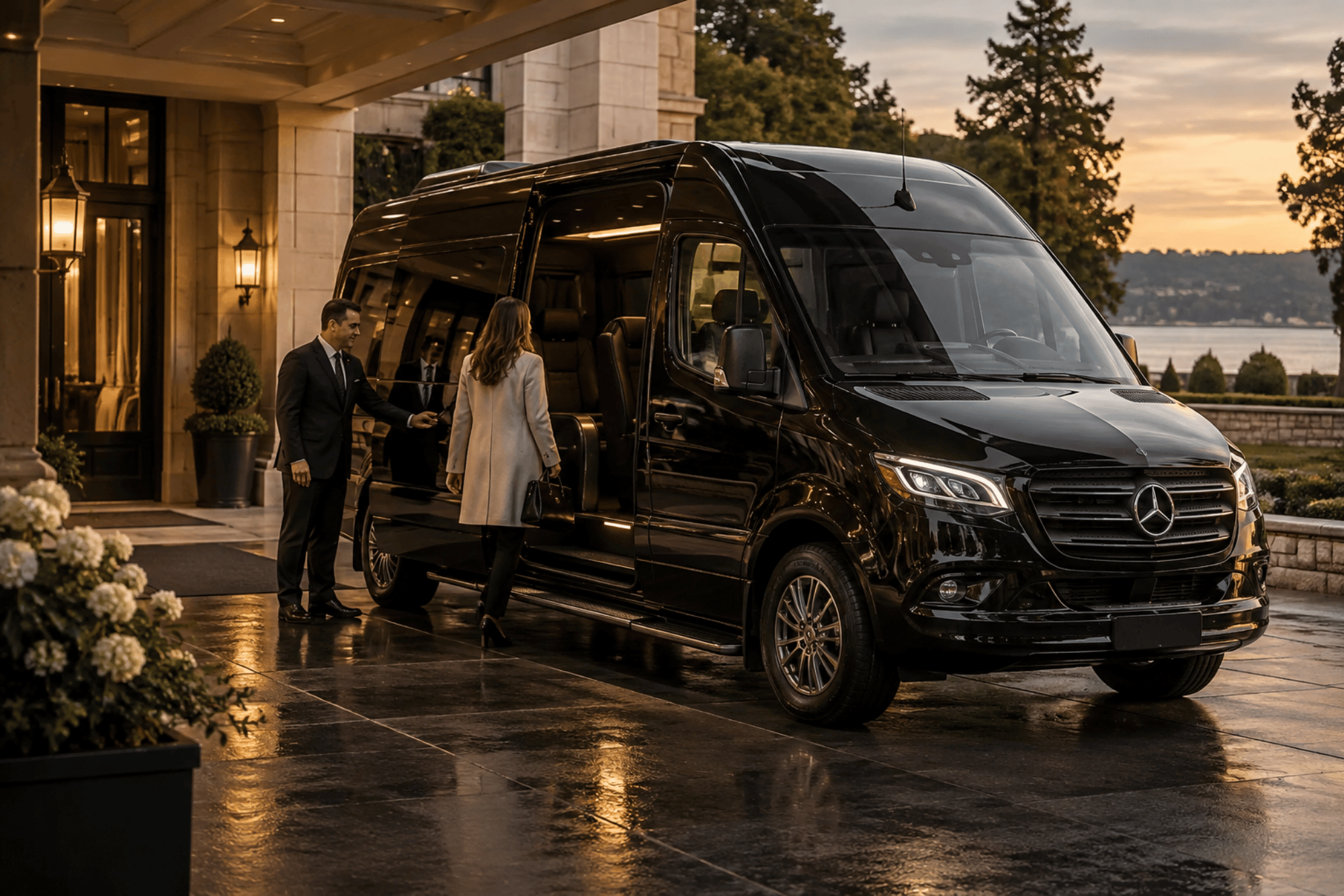
Guest shuttles. Nine passenger and fifteen passenger Mercedes-Benz Sprinters running loops between hotels, parking areas, train stations, and the venue. Note that Sprinters cannot use the Merritt, Hutchinson River, or Saw Mill parkways, which affects routing between many Westchester and Fairfield County hotels and venues. We plan for it.
Airport arrivals. Out-of-town guests and family met at JFK, LaGuardia, Newark, Westchester County Airport, and Teterboro through our airport car service, coordinated as a single manifest.
The statement arrival. For a couple's exit, a milestone birthday, or a guest of honor, exotic vehicles including Rolls-Royce models are available by inquiry.
Standby vehicles. One or two SUVs held for early departures, guests who should not drive, and the unexpected.
The full lineup is on our fleet page, and the service is described on our event chauffeur and transportation page.
Weddings: Particular Considerations
Weddings carry more emotion and more family complexity than any other event, and the planning should reflect it.
- The uninvited guest. A former partner, an estranged relative, or someone with a grievance. If the couple or their families have any such concern, tell the security lead in confidence, with a name and a photograph. It is handled quietly at the entrance and the couple never hears about it.
- Gifts and cards. Envelopes are a known target. Assign an agent or a trusted family member to the gift table and move cards to a secure location early.
- Multiple locations. Ceremony, photographs, reception, after-party, and hotel. Each move is a transportation event. A written timeline with vehicle assignments prevents the bridal party from standing on a church sidewalk.
- Estates and private homes. A wedding at a family residence opens the property to hundreds of people. See our guide to residential and estate security for how agents manage private-home events.
- Family elders and guests with limited mobility. Dedicated vehicles with patient chauffeurs, and drop-off as close to the door as the venue allows.
- The end of the night. A final shuttle time announced in advance, a few standby vehicles, and a planned exit for the couple.
Westchester and Fairfield County venues, from Hudson River estates to Greenwich clubs and Long Island Sound waterfront properties, often have narrow approaches and limited parking. Shuttle service from hotels in White Plains, Tarrytown, Stamford, and Greenwich is frequently the only practical option, and it should be planned with the venue's driveway in mind.
Galas and Public Events in New York City
Manhattan adds its own conditions.
- Curb space is contested. Venue entrances on major avenues allow seconds, not minutes. Drivers need exact instructions and a staging location nearby.
- Step-and-repeat arrivals are public and photographed. Principals who want to avoid them need a confirmed secondary entrance.
- Street closures around major events, parades, and United Nations week in September affect routes and timing across the East Side.
- Armed agents face venue restrictions. Many venues prohibit firearms regardless of licensing. Most event work is unarmed, and should be.
- Departures stack up. Dozens of black SUVs all look alike at 11:00 PM. Agents and drivers communicate directly so the right vehicle is at the door at the right moment.
Corporate Events
For shareholder meetings, investor days, and leadership gatherings, the plan adds a few elements: coordination with the company's security director, controlled arrivals for executives and directors through non-public entrances, awareness of protest activity, and group transportation for leadership teams. We cover corporate requirements in CEO and Executive Security Programs and handle the vehicles through our corporate transportation service.
Handling the Difficult Moments
Planners ask us how specific situations are handled. The honest answers are undramatic.
A guest who is not on the list. The agent is friendly, steps the guest aside so the line keeps moving, and contacts the planner. Most cases are an oversight and are resolved in a minute. Nobody is embarrassed at the door.
A person the hosts have asked us not to admit. Agents know the name and face in advance. The person is met before reaching the entrance, spoken to privately and respectfully, and asked to leave. If they refuse, police are called. The hosts are told afterward, not during the first dance.
An intoxicated guest. The preferred solution is a friend and a ride home. An agent stays close, arranges a standby vehicle, and makes it easy to leave with dignity.
Photographers or press at the entrance. On public property they are within their rights. The answer is a private arrival point and a short walk, planned in the advance.
A protest at a corporate event. The plan will already include alternate entrances and routes. Executives arrive and leave away from the public entrance, and agents do not engage.
A medical emergency. Agents are trained in first aid, CPR, and AED use, know the venue's address and nearest hospital, and meet the ambulance at the entrance.
Severe weather. Shuttle timing is extended, covered loading points are arranged with the venue, and guests are told of changes through the planner.
A principal who wants to leave now. The vehicle is staged and attended for exactly this reason. Two minutes, through the planned exit.
What It Costs, in General Terms
We quote every event privately, because the variables differ each time. The main drivers are:
- The number of agents and hours, including the advance and the briefing
- Armed or unarmed, which for events is almost always unarmed
- The number and class of vehicles, and whether they are dedicated or running a loop
- The date. Peak season Saturdays and holidays carry premiums.
- Airport transfers and multi-day guest movements
- Distance and travel time
Booking security and transportation together removes duplicated minimums and coordination time, and produces one itemized proposal. We explain protective pricing more fully in What Does Executive Protection Cost in New York.
A Planning Timeline
Eight or more weeks out
- Identify principals and VIPs and any specific concerns.
- Engage the security and transportation provider.
- Reserve vehicles, particularly Sprinters in peak wedding and holiday seasons.
Four to six weeks out
- Venue advance with the planner and venue manager.
- Draft the arrival, staging, and departure plan.
- Collect hotel lists and estimate shuttle demand.
- Collect guest flight details for airport transfers.
Two weeks out
- Finalize agent numbers and positions.
- Finalize the shuttle schedule and publish it to guests.
- Confirm the guest list format for the door team.
- Share names and photographs of anyone of concern, in confidence.
The week of
- Final timeline with vehicle assignments, distributed to planner, venue, and team leads.
- Confirm driver and agent names with the venue.
- Weather check and contingencies.
The day
- Team briefing on site before vendors load in.
- Communications check.
- One lead on site for the planner to call for anything.
After
- A short debrief with the planner. Anything noted is reported.
Shorter timelines are possible. We regularly staff events on a week's notice, and sometimes less. More time produces a better plan.
What Planners Should Ask a Provider
- Do you hold a security agency license, a transportation license, or both?
- Are agents, drivers, and vehicles yours, or subcontracted?
- Will you conduct an advance and provide a written plan?
- Who is the on-site lead, and will I meet that person beforehand?
- How will agents be dressed?
- How do you handle a guest who is not on the list?
- How do you coordinate with the venue's security and with valet?
- What insurance do you carry, and can you name the venue and host on a certificate?
- Will everyone assigned sign a non-disclosure agreement?
- Do you post client events on social media? The answer should be no.
Our guide to hiring a bodyguard in New York explains how to verify security licensing.
Frequently Asked Questions
How many agents does an event need?It depends on the number of entrances, the number of principals, the guest count, and any specific concern. After an advance we recommend a number and explain the reasoning.
Will security be visible to guests?Only as well-dressed, courteous staff. Most guests will not realize agents are present.
Can you provide only transportation, or only security?Yes. Many events book one or the other. The advantage of booking both is a single coordinated plan.
Can you handle guest airport pickups across several days?Yes. We work from a flight manifest and track every arrival.
Do you work with our planner and venue?Always. We take direction from the planner and respect the venue's procedures.
How far in advance should we book?As early as possible for peak season Saturdays and the December holidays. Call (914) 653-6228 for short-notice events.
What areas do you cover?Westchester County, Fairfield County, New York City, and surrounding areas. See the FAQ for policies.
Plan Your Event With One Team
Send us the date, the venue, the guest count, and anything that concerns you. We will return a coordinated security and transportation proposal. Call (914) 653-6228, send an inquiry, or reserve vehicles online.
One team. One plan. One point of contact.




.png)

